

 Performance Marekting
Meta Ads vs Google Ads: Which Should Get Your Budget First in 2026?
You have a limited advertising budget, a product or service to sell, and two platforms competing for your attention: Google...
Read Full Article →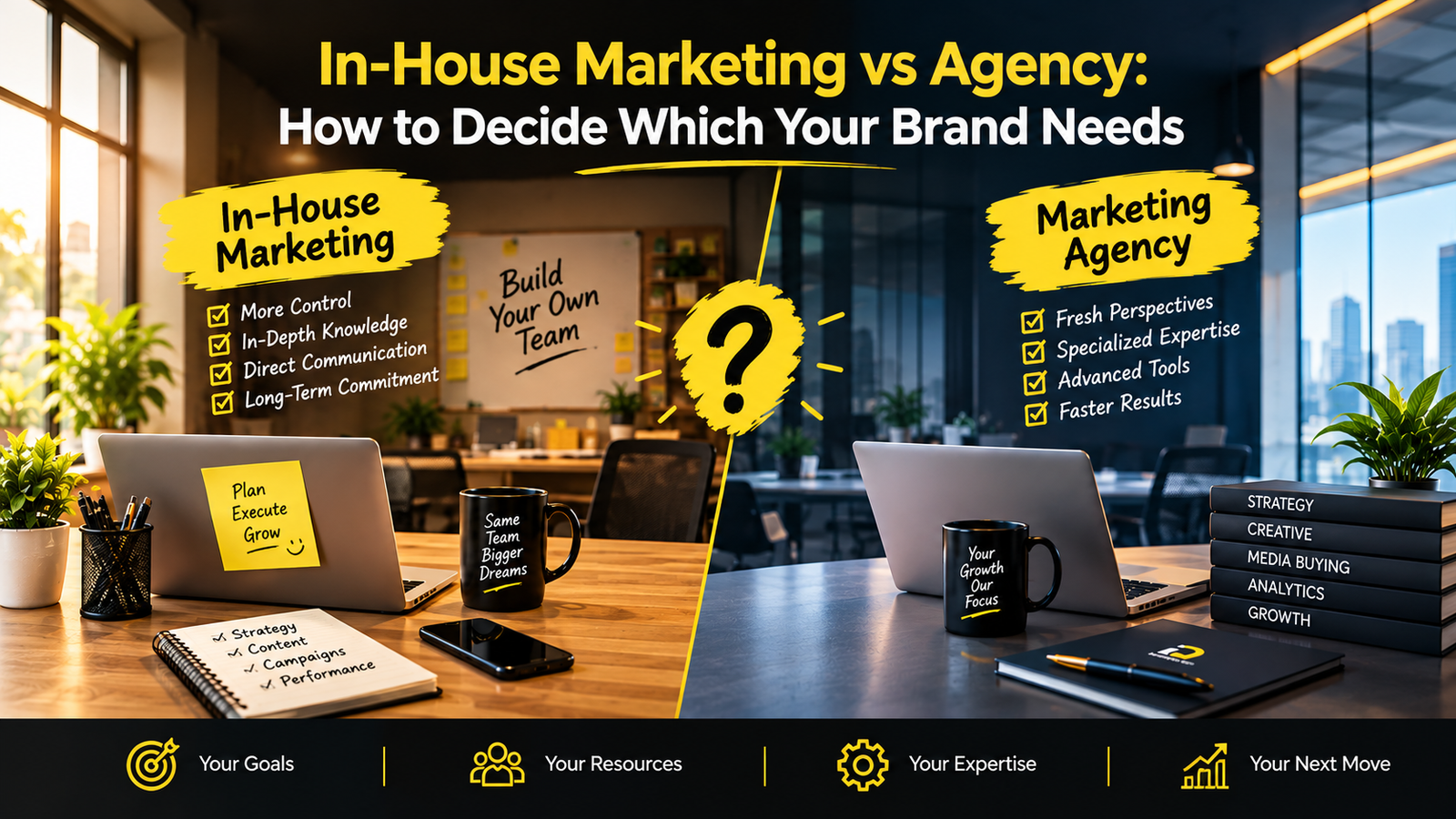
You’ve got a growth target, a finance team watching every rupee, and one important question: Should you build an in-house marketing team or hire a marketing agency?
The answer isn’t simply about comparing salaries with agency retainers.
An in-house team can give you deep product knowledge, closer collaboration, and greater day-to-day control. An agency can give you access to specialists, broader channel experience, and additional capacity without requiring you to hire every skill internally.
We’re an agency, so there is an obvious perspective to account for. The goal here isn’t to argue that agencies are always better. In some situations, building in-house is the more practical choice.
The right decision depends on your goals, workload, internal capabilities, budget, and the type of marketing work you need to get done.
Most in-house marketing vs agency discussions begin with a salary-versus-retainer comparison.
That’s not the best place to start.
Ask a more useful question:
What marketing work isn’t getting done today, and what is preventing it from getting done?
Is the problem:
These questions can point you toward a more suitable structure.
HubSpot’s 2026 State of Marketing report found that 73% of marketers say their budgets are receiving more scrutiny than in the past, while 33% identify measuring marketing ROI as their biggest challenge. The report also highlights changing skill requirements and continued pressure on marketing teams to demonstrate business impact.
So instead of asking only, “Which option is cheaper?”, ask:
“Which setup gives us the skills and capacity we need over the next 6–12 months?”
| Factor | In-House Team | Marketing Agency |
| Product and brand knowledge | Deep and develops over time | Builds through client collaboration |
| Range of skills | Depends on who you hire | Access to multiple specialists |
| Cost structure | Salaries, benefits, tools and other employee costs | Retainer or project-based fees |
| Control | High day-to-day control | Shared responsibility |
| Scaling capacity | Usually tied to hiring | Scope can often be adjusted more quickly |
| Best suited for | Continuous work and deep internal context | Specialist skills, testing and additional capacity |
There isn’t a universal winner.
Each model solves different problems.
The important question is which model matches your specific marketing requirements.

A marketing agency can be useful in several situations.
Suppose you want to launch or improve:
Hiring and onboarding specialists can take significant time. An agency may give you access to people who already work on those functions.
Marketing workload isn’t always consistent.
You might have:
Hiring a full-time employee for a temporary workload may not make sense.
A project-based or scoped agency engagement can provide additional capacity without permanently increasing headcount.
Sometimes the problem isn’t that you need another employee.
You need a particular capability.
For example:
“We have a marketing manager, but nobody on the team knows technical SEO.”
Or:
“We have a performance marketer, but we need better creative testing.”
In such cases, an agency or specialist partner can fill the skill gap without requiring you to build an entire department.
An experienced agency may bring benchmarks, testing experience, and lessons from working across multiple campaigns and accounts.
That outside perspective can be useful when an internal team has become too focused on its existing assumptions.
But don’t assume an agency automatically understands your business.
Your team still needs to provide the product knowledge, customer context, margins, goals, and commercial constraints required to make good decisions.
An in-house marketing team can make more sense when the work is continuous and closely connected to the product and customer.
This can include:
An in-house team can also be useful when one marketing channel has enough consistent volume to keep a specialist occupied throughout the year.
For example, if paid acquisition is a major and continuous part of your business, having an internal performance marketer may eventually make sense.
Some decisions depend heavily on information that sits inside the company:
When marketing decisions need constant access to this context, internal ownership can be valuable.
If nobody currently owns growth, consider making your first marketing hire someone senior enough to own strategy, measurement, priorities, and external partners, rather than focusing only on execution.
That doesn’t mean every company needs a senior marketing leader as its first hire. The appropriate role depends on the company’s stage, budget, and existing capabilities.
You don’t necessarily have to choose between completely in-house marketing and completely outsourced marketing.
A hybrid model combines both.
One possible structure is:
Have someone inside the business responsible for:
Bring in an agency where you need additional expertise or execution capacity.
For example:
As a particular function becomes predictable and large enough to justify a full-time role, you can consider bringing it internally.
For example, a growing brand might eventually build its own:
An agency can remain useful for:
The right hybrid structure will vary by company.
The goal isn’t to outsource everything or keep everything internally. It’s to decide which responsibilities need internal ownership and which are better supported externally.
Before choosing between an in-house team and an agency, answer these five questions.
If strategic decisions depend heavily on your product, customers, pricing, and internal operations, keeping strategic ownership in-house may make sense.
If the problem is specialist execution or a specific capability, an agency may be useful.
In many cases, the answer is both.
Continuous work may justify an internal role.
Short-term or unpredictable work may be better suited to an external partner.
For example:
Continuous:
CRM, email, community, daily brand management.
Spiky:
Website redesign, product launch, seasonal campaign, market expansion.
This is one of the most important questions when hiring an agency.
If nobody inside the business owns the relationship, briefs, approvals, reporting, and goals, even a capable agency can struggle.
You need someone who can:
Before increasing marketing spend, establish:
HubSpot’s 2026 research identifies measuring marketing ROI as the top challenge among surveyed marketers, making measurement an important consideration regardless of whether the work is handled internally or externally.
This is where many comparisons go wrong.
For an in-house employee, consider:
For an agency, consider:
Compare the total cost of getting the work done, not simply an employee’s salary against an agency’s monthly retainer.
If you decide to work with an agency, establish the relationship properly from the beginning.
Your company should retain appropriate ownership and access to important assets such as:
Don’t build your entire marketing infrastructure around an account that only the agency controls.
Ask:
The person selling the engagement isn’t necessarily the person doing the day-to-day work.
Don’t rely only on impressions and clicks.
Depending on the business model and channel, relevant KPIs might include:
The right KPI depends on the business objective.
Set a formal review point at the beginning of the engagement.
A 90-day review can be a useful starting point, but the appropriate evaluation period depends on the channel.
Paid campaigns may generate meaningful performance signals relatively quickly.
SEO, content, brand building, and other longer-cycle activities can require more time.
Agree in advance on:
Credentials shouldn’t be the only factor you consider, but they can provide useful information.
For Google Ads agencies, Google’s Partners program is designed for advertising agencies and third parties managing Google Ads accounts for other businesses. Companies can earn Google Partner status by meeting requirements across Performance, Spend, and Certifications.
However, a Google Partner status doesn’t automatically demonstrate that an agency is the right fit for your company.
Also ask for:
A credential tells you something about the agency.
It doesn’t tell you everything.

There isn’t a universal answer to whether an in-house team or agency is cheaper.
The answer depends on:
A small company might find an agency more practical because it can access multiple specialists without hiring several employees.
A larger company with substantial and predictable marketing requirements may eventually find that building internal capabilities makes more sense.
The important point is to compare fully loaded costs and expected business outcomes, not just monthly salary versus monthly retainer.
Start by writing down one marketing outcome you need to achieve over the next 90 days.
Then identify:
If you have the internal ownership but lack specialist skills or execution capacity, an agency may be worth considering.
If you need deeper product knowledge, continuous ownership, or a capability that will remain busy year-round, building in-house may make more sense.
And if you need both, a hybrid model can combine internal ownership with external specialist support.
If you want to explore a scoped marketing engagement, talk to DigiAddaBox about performance marketing, SEO, social media, and other digital marketing services.
Digiadda partners with ambitious brands to drive predictable customer acquisition and retention with data-backed performance systems.
Book a Growth Consultation →It depends on what you include in the calculation. Compare the fully loaded cost of salaries, benefits, recruitment, tools, training, and management time with an agency’s fees, media costs, and internal management requirements. Salary versus retainer alone isn’t a fair comparison.
There isn’t one universal stage. Before hiring an agency, establish as much clarity as possible around your customer, offer, positioning, goals, and measurement. An agency can then focus its time on execution, specialist skills, testing, or scaling rather than spending the entire engagement resolving foundational business questions.
Yes. A hybrid model can work when the internal team owns strategy, business context, priorities, and measurement while an agency provides specialist expertise or additional execution capacity.
Start by reviewing relevant certifications, partnerships, case studies, references, and experience. For Google Ads specifically, you can check whether an agency participates in Google’s Partners program and whether it has Partner or Premier Partner status. Google says Partner status is based on Performance, Spend, and Certifications requirements.
Set a formal review point before the engagement begins. Ninety days can be a useful starting point, but the right timeframe depends on the marketing channel. Paid advertising may produce meaningful signals relatively quickly, while SEO, content, and brand-building activities generally require a longer evaluation period.
A hybrid marketing model combines internal marketing ownership with external specialists or agencies. For example, a company might keep its marketing lead, CRM, and brand management in-house while using an agency for SEO, paid advertising, creative testing, or other specialist functions.
 Performance Marekting
You have a limited advertising budget, a product or service to sell, and two platforms competing for your attention: Google...
Read Full Article → Video Production
You paid for a beautifully shot brand film. It has 40,000 views, a nice comment section, and no line item...
Read Full Article →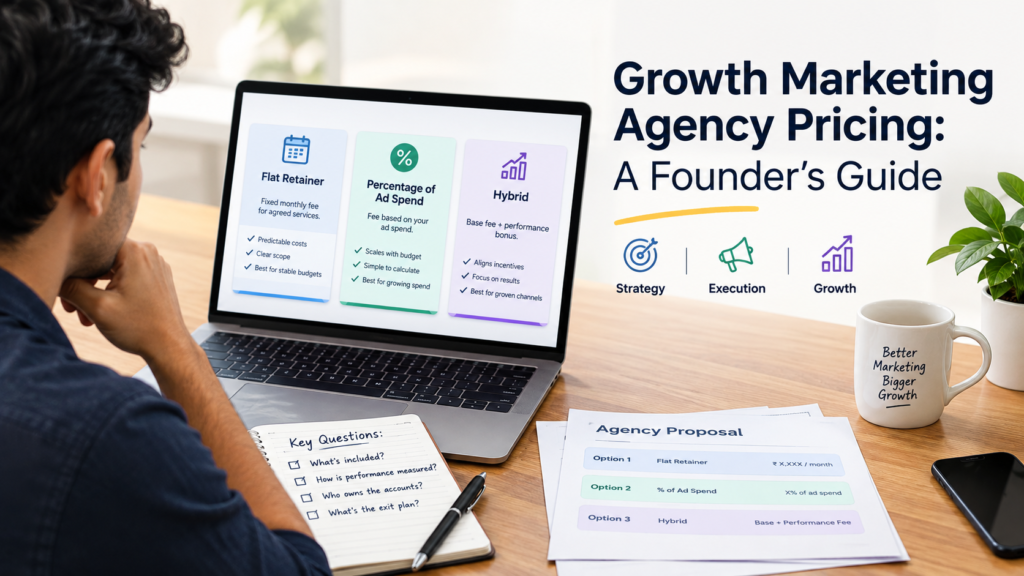 Performance Marekting
Three proposals are on your desk. One is a flat monthly fee. Another charges a percentage of ad spend. The...
Read Full Article → E-commerce
Introduction Search engine optimization (SEO) helps businesses attract relevant visitors from search engines, but the right strategy depends on what...
Read Full Article → Digital Marketing
Introduction Your real estate marketing campaign generates thousands of leads, but your sales team struggles to turn those enquiries into...
Read Full Article → Digital Marketing
Most CA firms in India still grow through referrals. But a referral now often ends the same way: someone searches...
Read Full Article →
Discussion (0)