

 Blog
Conversion Rate Optimization for E-commerce: 12 Fixes That Actually Move the Needle
Getting more visitors to your store doesn’t always mean getting more orders. If your traffic has increased but sales haven’t...
Read Full Article →
You have a limited advertising budget, a product or service to sell, and two platforms competing for your attention: Google Ads and Meta Ads.
Google can help you reach people actively searching for a product or service. Meta Ads can introduce your brand to people based on their interests, behaviours and other available targeting signals, even when they are not actively looking to buy.
Both platforms can generate leads and sales. The challenge is deciding which one deserves your first investment-and when it makes sense to use both.
The answer depends on your business model, customer journey, conversion tracking, competition and budget. It also depends on what you mean by a successful campaign: a lead, a qualified enquiry, a purchase or a profitable customer.
This guide explains the differences between Meta Ads and Google Ads, how their optimisation requirements affect budget planning, and how Indian businesses can decide where to invest first.
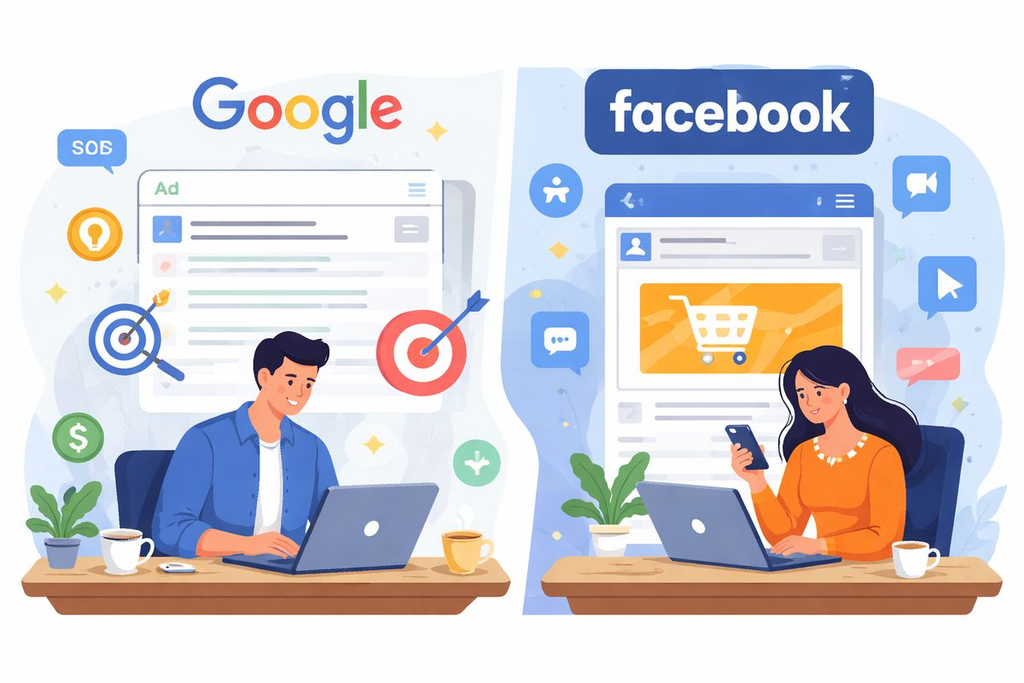
The simplest distinction is demand capture versus demand generation.
Google Search Ads can capture existing demand when someone searches for a solution. Meta Ads can help create awareness, generate interest and encourage people to consider a product or service they may not have been actively searching for.
The distinction is useful, but it is not absolute. Google also offers campaign formats designed to reach audiences beyond Search, while Meta can reach people who are already familiar with a brand and ready to purchase.
Here is how the platforms compare.
| Factor | Meta Ads | Google Ads |
| Main opportunity | Generate interest and demand | Capture existing search demand and reach audiences across Google inventory |
| Common placements | Facebook, Instagram and other eligible placements | Google Search, YouTube, Display and other eligible inventory |
| Targeting approach | Audiences, interests, behaviours, custom audiences and signals | Search queries, keywords, audiences, locations and automated signals, depending on campaign type |
| Creative approach | Images, Reels, videos, carousels and other formats | Search text ads, product feeds, video, display creatives and other formats |
| Strong use cases | D2C products, visual brands, discovery and retargeting | High-intent services, products people actively search for and demand capture |
| Important metric | Cost per qualified lead, purchase cost and contribution margin | Cost per qualified lead, purchase cost and contribution margin |
| Common challenge | Turning attention into profitable action | Competing for valuable searches and controlling acquisition costs |
Neither platform is automatically cheaper or better. The platform that works best is the one that reaches the right audience and generates valuable conversions at a sustainable cost.

Meta Ads can be a strong starting point when customers need to discover your brand, understand your product or see why it is different from alternatives.
This is particularly relevant for businesses that can communicate their value through visual content, demonstrations, testimonials or compelling offers.
Suppose you sell skincare, apparel, accessories, home decor or another consumer product.
A potential customer may not search for your brand by name because they do not know it exists. A relevant Instagram Reel or Facebook ad can introduce the product, demonstrate its use and give the customer a reason to visit your website.
Meta can help you test:
However, engagement alone does not prove that a campaign is profitable. A video with many views can still generate very few sales.
Some products require explanation before a customer is ready to buy. A short video, carousel or testimonial may help people understand the problem your product solves.
For example, a new fitness accessory brand could use demonstration videos to show how its product fits into a customer’s routine. A furniture brand could use lifestyle imagery and room transformations to communicate design and functionality.
In both cases, the advertising helps people discover and evaluate the product.
Meta is also useful for businesses that want enquiries rather than direct online purchases.
A real estate company might promote a project through a video and collect enquiries using a lead form. An event management company might advertise its services to relevant audiences and encourage potential clients to start a conversation.
But a low cost per lead is not enough. Businesses should also track how many leads are reachable, relevant, qualified and likely to convert.
When Meta Ads may be the better first test:
Google Ads can be a strong starting point when people already know what they need and actively search for a solution.
This makes Google Search particularly relevant for businesses offering services or products with clear search intent.
Imagine someone searches for:
These searches can indicate an existing need. A relevant search ad may connect the person with a suitable provider at the moment they are evaluating options.
This does not guarantee a sale. Search intent, competition, keyword relevance, landing-page quality, pricing and trust all influence the outcome.
For many service providers, the customer begins with a problem and searches for a professional who can solve it.
A digital marketing agency, chartered accountant, home renovation company or business software provider may find valuable opportunities through relevant search campaigns.
For example, a business targeting “GST registration consultant” can create a focused landing page explaining the service, eligibility, process and next steps.
The campaign can then be assessed using qualified enquiries, booked consultations and actual customer acquisition cost.
Google Shopping and other eligible campaign formats can help e-commerce businesses reach shoppers researching or comparing products.
This may be especially useful when customers already know the product category or use specific product-related searches.
The results still depend on factors such as product pricing, competition, product feed quality, availability, landing-page experience and campaign settings.
When Google Ads may be the better first test:
This is where budget decisions often become confusing.
Both platforms use automated systems to help optimise campaign delivery. Those systems benefit from useful conversion data, but the requirements differ by platform, campaign type and bidding strategy.
A commonly cited Meta benchmark is approximately 50 optimisation events within seven days per ad set for an ad set to exit the learning phase. This is a learning-phase benchmark, not a universal minimum budget or a guarantee of performance. Actual delivery and learning can vary.
Google Ads has different requirements depending on the bidding strategy. For example, Google’s guidance for Target ROAS in Search and Shopping campaigns specifies at least 15 conversions in the previous 30 days at the conversion tracking level. This requirement should not be applied to every Google Ads campaign or bidding strategy.
The two figures are therefore not directly comparable. One relates to Meta’s learning phase; the other relates to eligibility for a particular Google automated bidding strategy.
Assume your expected cost per conversion is ₹600.
| Example | Calculation | Illustrative spend |
| 50 Meta optimisation events in seven days | 50 × ₹600 | ₹30,000 |
| 15 Google Ads conversions over 30 days | 15 × ₹600 | ₹9,000 |
These are arithmetic examples, not recommended budgets for every business.
The calculation assumes that each event or conversion costs ₹600. In reality, costs vary by campaign, industry, audience, bidding strategy and conversion quality. Meta optimisation events and Google Ads conversions may also represent different actions, making the numbers unsuitable for a direct platform-performance comparison.
A campaign can run without meeting a particular benchmark. However, automated optimisation may be less predictable, or a particular bidding strategy may not yet be appropriate.
Before setting a budget, consider:
The practical takeaway: Do not select a platform simply because one published conversion threshold looks lower. Select the campaign based on your business objective, the available demand and the quality of conversion data you can generate.
There is no universal budget split that works for every business.
A company selling a new consumer product may need to create demand before customers start searching for its brand. A service provider with strong existing search demand may have a clearer starting point with Google Search.
The right allocation should follow the customer’s buying journey and the evidence from your campaigns.
Start with the channel that offers the clearest route to a valuable conversion.
If customers actively search for your service, test a focused Google Search campaign using relevant keywords, carefully chosen locations and a suitable landing page.
If your product depends on discovery and visual explanation, a focused Meta campaign may be a more useful first experiment.
Do not split a small budget across multiple campaigns, audiences and ad sets simply to be present everywhere. Too many fragmented tests can make it harder to interpret results.
A small retargeting campaign may be worth testing later, once your website has enough relevant visitors and the audience is large enough to support delivery.
Consider testing both platforms when each has a clear role.
For example:
Make sure you can distinguish between new customer acquisition and conversions from people who were already familiar with the brand.
A larger budget gives you more room to test campaigns, creatives, audiences and landing pages. It does not remove the need for a clear strategy.
You can explore different customer segments, test additional campaign types and evaluate how the platforms contribute to the overall buying journey.
Scale campaigns based on business outcomes, not spend alone. A campaign that generates more revenue may still be less profitable if its product margins, fulfilment costs or customer acquisition costs are worse.
Choosing the right conversion event matters because the platform optimises towards the action you tell it to pursue.
For an e-commerce business focused on sales, purchase is generally the preferred optimisation event when there is enough purchase data to support it.
But some new stores receive very few purchases. In that situation, a higher-funnel event such as add-to-cart may generate more signals. That can help the business understand whether people are engaging with the product page and beginning the buying process.
There is a trade-off: an add-to-cart is not a sale.
A campaign that produces many cart additions may still struggle with checkout completion, product pricing, shipping costs or payment friction.
Before changing the optimisation event, ask:
Choose an event that reflects the outcome you want. Use higher-funnel events only when there is a clear reason to do so, and evaluate whether the additional signals lead to better business results.

Brand campaigns target searches that include your company or product name. They can help you capture relevant searches, but they should not automatically be treated as the cheapest or most incremental conversions.
For example, someone who searches for your business by name may already know about you through a referral, organic search, previous advertising or an existing customer relationship.
A brand campaign could capture that demand, but the conversion may not have occurred solely because of the ad.
If your brand already receives searches, consider testing brand and category campaigns separately.
Evaluate:
Brand ads can be useful, particularly in competitive markets, but their value should be judged in the context of the wider marketing mix.
ROAS, or return on ad spend, measures the revenue attributed to advertising relative to the ad spend.
For example, if you spend ₹20,000 and your campaigns report ₹80,000 in attributed revenue, your reported ROAS is 4x.
That does not automatically mean the campaign is profitable.
The business may still need to account for product costs, shipping, discounts, payment processing, returns, salaries, agency fees and other expenses. Attribution settings can also influence which campaign receives credit for a sale.
For lead generation businesses, revenue may arrive weeks or months after the original enquiry. In that case, cost per lead is only an early indicator, not the final measure of success.
| Business model | Useful metrics |
| E-commerce | Cost per purchase, conversion rate, average order value, contribution margin and new-customer acquisition cost |
| Lead generation | Cost per qualified lead, contact rate, booked meetings, sales conversion rate and cost per customer |
| Real estate | Cost per qualified enquiry, site visits, bookings and cost per booking |
| B2B services | Qualified opportunities, meeting-to-sale rate, sales cycle and customer acquisition cost |
| Brand awareness | Reach, frequency, relevant engagement and assisted conversions, interpreted alongside business outcomes |
Use the same definitions and comparable time periods when evaluating Meta Ads and Google Ads. Also allow for the time it takes for conversions to happen and be reported.
A platform that produces fewer but better-quality leads may be more valuable than one that produces a high volume of low-quality enquiries.
Cost per click tells you how much you pay for a click. It does not tell you how much you pay for a customer.
A lower CPC can still lead to a higher acquisition cost if the traffic converts poorly.
Campaign performance can change as the platform gathers data, the audience responds to creative, and the business improves its landing pages.
Avoid judging every campaign on a few early clicks. At the same time, do not continue spending indefinitely on a campaign that is clearly failing to produce meaningful results.
Set an evaluation period appropriate to your conversion volume, sales cycle and business risk.
Changing targeting, budgets, creatives, conversion events and bidding strategies simultaneously makes it harder to understand what affected performance.
Where possible, make measured changes and document what you changed. Monitor conversion volume, acquisition cost and the time required for conversions to be reported.
Even a relevant ad can underperform if the landing page is slow, confusing or inconsistent with the offer.
Make sure the page clearly explains the product or service, answers common questions and provides a straightforward next step.
A campaign can report a low cost per lead while generating enquiries that never become customers.
Connect advertising data to your CRM or sales records wherever practical. Track which campaigns generate reachable leads, qualified opportunities and actual sales.
Meta and Google can serve different purposes within the same marketing strategy. One can introduce the brand while the other captures active demand.
The right mix depends on your business, not on a rule that every advertiser must use both platforms.
Use these questions to identify a sensible starting point.
| Question | What it may indicate |
| Are customers actively searching for your service? | Test Google Search if relevant, commercially valuable searches exist |
| Does your product need to be demonstrated or discovered? | Test Meta creative and audience approaches |
| Do you have reliable conversion tracking? | If not, address tracking before making major scaling decisions |
| Are you generating enough sales or qualified leads to evaluate? | Use conversion quality and volume to guide the next test |
| Is the website converting paid traffic effectively? | Review landing-page and funnel performance before increasing spend |
| Can you identify which leads become customers? | Connect campaign data with CRM or sales outcomes where possible |
Step 1: Define the business outcome. Decide whether you want purchases, qualified leads, booked consultations or another measurable result.
Step 2: Check tracking. Verify that the relevant conversion event fires correctly and that duplicate or low-quality events are not distorting your reporting.
Step 3: Choose the clearest initial channel. Start with the platform most closely aligned with your customers’ behaviour and buying journey.
Step 4: Keep the test focused. Avoid spreading the budget across too many campaigns, audiences or creatives before you have useful evidence.
Step 5: Review conversion quality. Assess sales, qualified leads and acquisition costs—not only clicks, impressions or platform-reported ROAS.Step 6: Expand based on evidence. Test the second platform or scale the stronger campaign when the data supports the decision.
There is no universal winner in the Meta Ads vs Google Ads comparison.
Google Search can be a strong starting point when people are actively looking for the solution you offer. Meta can be valuable when you need to introduce a product, communicate its benefits or generate interest among relevant audiences.
Your decision should also account for campaign type, conversion tracking, budget, customer journey and the quality of the results.
Do not treat Meta’s learning-phase benchmark and Google’s Target ROAS requirements as directly comparable budget rules. They describe different platform conditions and do not guarantee profitable performance.
Start with a clear business objective, measure meaningful conversions and make budget decisions based on evidence. Once you understand how each channel contributes to sales or qualified leads, you can build a more effective advertising mix.
At DigiAddaBox, we help businesses approach paid advertising with a focus on strategy, campaign performance and measurable business outcomes.
If you are unsure whether Meta Ads, Google Ads or a combination of both makes sense for your business, start by reviewing your current campaigns, tracking setup and conversion funnel.
Talk to an Expert: Contact
Digiadda partners with ambitious brands to drive predictable customer acquisition and retention with data-backed performance systems.
Book a Growth Consultation →Neither platform is universally better. Meta Ads can be effective for discovery, visual storytelling and audience-based campaigns. Google Search Ads can be effective for capturing existing demand. The better choice depends on your customers, offer and business objective.
Not necessarily. Costs vary by industry, competition, targeting, campaign type and conversion objective. Compare the cost of qualified leads or customers rather than CPC alone.
There is no single minimum budget that guarantees useful results. Estimate your likely conversion cost, decide how much you can afford to test and avoid dividing a small budget across too many campaigns. Your budget should reflect your objective and expected conversion volume.
The appropriate budget depends on keyword costs, search volume, competition, conversion rates and the value of each customer. Begin with a focused campaign and a realistic testing budget, then evaluate the quality and cost of conversions.
Approximately 50 optimisation events within seven days per ad set is a commonly cited benchmark for exiting Meta’s learning phase. It is not a universal minimum budget or a guarantee of results. Campaign delivery and learning depend on the setup and available data.
Google’s guidance specifies at least 15 conversions in the previous 30 days for Target ROAS in Search and Shopping campaigns. This is specific to that bidding strategy and those campaign types; it is not a universal requirement for every Google Ads campaign.
A new business should start with the channel that provides the clearest route to a valuable conversion. Google Search may suit an offer people already search for. Meta may suit a product that needs awareness or demonstration. Test based on customer behaviour and available evidence.
Yes. The platforms can play complementary roles. Meta may help generate interest, while Google can capture relevant search demand. Use consistent conversion tracking and evaluate each channel’s contribution to qualified leads, sales and overall profitability.
For a sales-focused e-commerce campaign, purchase is generally preferable when there is enough reliable purchase data. Add-to-cart may provide more frequent signals in some situations, but it does not necessarily lead to profitable sales. Choose the event based on the business goal and available data.
It depends on your business model. E-commerce brands often examine ROAS alongside margins and acquisition costs. Lead-generation businesses should evaluate lead quality, customer conversion rates and the eventual revenue generated. Neither metric should be judged in isolation.
 Blog
Getting more visitors to your store doesn’t always mean getting more orders. If your traffic has increased but sales haven’t...
Read Full Article → Video Production
You paid for a beautifully shot brand film. It has 40,000 views, a nice comment section, and no line item...
Read Full Article →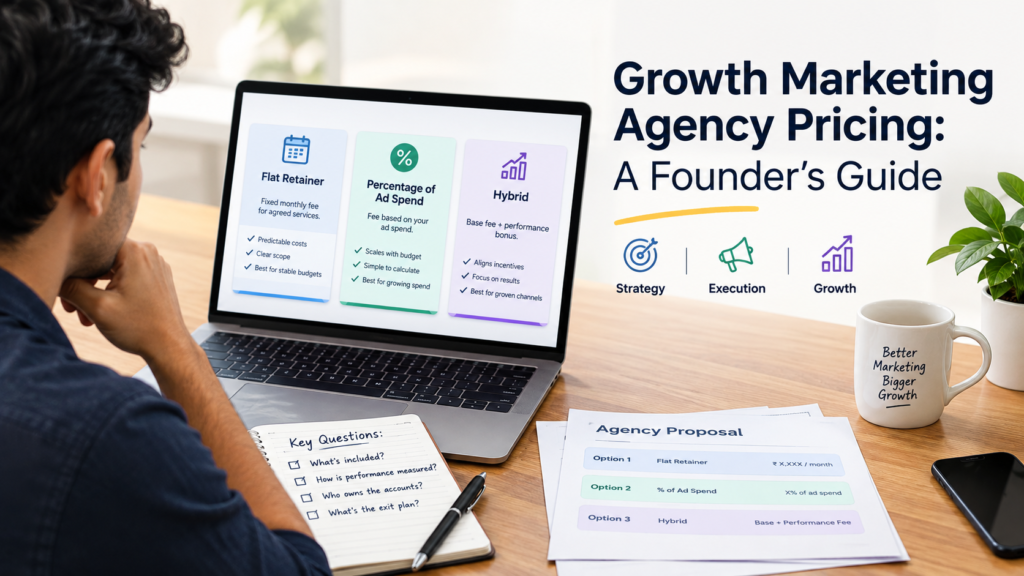 Performance Marekting
Three proposals are on your desk. One is a flat monthly fee. Another charges a percentage of ad spend. The...
Read Full Article → E-commerce
Introduction Search engine optimization (SEO) helps businesses attract relevant visitors from search engines, but the right strategy depends on what...
Read Full Article →
Performance Marekting
Three proposals are on your desk. One is a flat monthly fee. Another charges a percentage of ad spend. The...
Read Full Article → Performance Marekting
Picture a decorator with a stunning Instagram grid, a few thousand followers, and an inbox that only lights up when...
Read Full Article → Performance Marekting
If your Meta and Google spend is up and your blended CAC is worse than it was two years ago,...
Read Full Article →
Discussion (0)